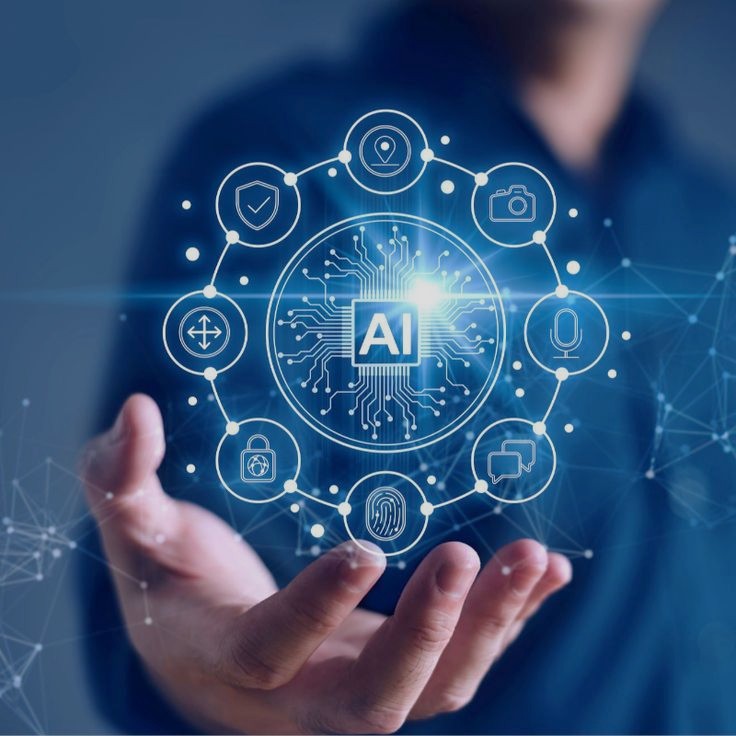
introduction smart future ai tool

 smart future ai tool  is a powerful part of modern technology which makes daily life smart and efficient. These ai tools are playing an important role in making the future intelligent.

digital marketing

smart future ai tool use your life

narrow ai

Narro AI:

2. High Performance in Specific Domains

Despite being limited in scope, narrow AI often outperforms humans in specific tasks, such as playing chess (e.g., IBM’s Deep Blue), diagnosing diseases, or optimizing supply chains. Its ability to process vast amounts of data at high speed is a major advantage in specialized fields.

3. Examples of Narrow AI

  • Voice Assistants: Systems like Siri, Google Assistant, and Alexa help with tasks like answering questions, setting reminders, and controlling smart devices, but they lack the ability to engage in conversations beyond their programmed scope.

  • Recommendation Systems: Netflix, Spotify, and YouTube use narrow AI to suggest content based on user preferences and past behavior.

  • Autonomous Vehicles: Self-driving cars like those developed by Tesla use narrow AI to navigate, avoid obstacles, and drive within traffic conditions, but they’re specialized for driving and can’t perform unrelated tasks.

  • Customer Service Chatbots: These bots can handle customer queries and requests, but they only work within predefined parameters and don’t understand complex or unstructured interactions like a human would.

4. Machine Learning and Deep Learning

A significant portion of narrow AI systems is powered by machine learning (ML), where algorithms learn from data to improve their performance over time. Some of these systems use deep learning, which involves neural networks that mimic human brain structures to identify patterns in large datasets. For instance, narrow AI can be used in image recognition or natural language processing tasks.

5. Benefits of Narrow AI

  • Efficiency: Narrow AI can process data much faster than humans, making it ideal for tasks like data entry, processing large datasets, and decision-making in real-time.

  • Accuracy: AI can eliminate human error in 

  •  tasks that require precision, such as medical imaging or financial analysis.

  • Availability: Unlike humans, narrow AI systems can work continuously without breaks, which is useful for tasks like customer support or monitoring systems.

6. Limitations of Narrow AI

  • Lack of Flexibility: Narrow AI cannot perform tasks outside its pre-programmed functions. For example, a chess-playing AI can’t shift to playing a musical instrument.

  • Dependence on Data: The quality and quantity of data are crucial for narrow AI’s success. Poor data can lead to poor performance or biases.

  • No True Understanding: Narrow AI doesn’t have comprehension or consciousness. It can only perform tasks based on patterns in data, without understanding context in the way humans do.

7. Ethical Considerations

  • Bias: Since narrow AI systems learn from data, if that data reflects biases (e.g., racial, gender, or economic biases), the AI can perpetuate or amplify those biases.

  • Job Displacement: Automation driven by narrow AI has led to concerns about replacing human workers in industries like manufacturing, retail, and transportation.

  • Privacy: AI-powered tools like surveillance systems, smart assistants, and facial recognition raise privacy concerns, especially in how personal data is collected, stored, and used.


8. Future of Narrow AI

Although narrow AI is highly  specialized, its applications are expanding rapidly across various sectors. The integration of AI in healthcare, transportation, finance, and even arts and entertainment is transforming industries. However, many experts believe that the real leap forward will come with Artificial General Intelligence (AGI), a more generalized form of AI that can handle a wider range of tasks like humas.

smart future ai technology

bg image

General AI (also referred to as Artificial General Intelligence or AGI) is the theoretical form of artificial intelligence that can understand, learn, and apply knowledge across a broad range of tasks,smart future ai toolmuch like a human being. Unlike Narrow AI (or Weak AI), which is designed to excel in specific domains, General AI would have the ability to perform any intellectual task that a human can.

Here’s a deeper dive into AGI:

1. Key Characteristics of General AI

  • Adaptability: AGI would be able to adapt to new and unfamiliar tasks without needing to be retrained or reprogrammed. Unlike narrow AI, which is task-specific, AGI would be versatile and capable of learning any task it is presented with smart future ai tool   

  • .

  • Autonomy: It could operate independently and make decisions based on understanding and reasoning, without human intervention.

  • Cognitive Flexibility: AGI would have the ability to understand abstract concepts, solve problems creatively, and transfer knowledge between different domains, just as humans can.

  • Common Sense: AGI would be expected to possess a form of common sense and contextual understanding, allowing it to make sense of the world and respond appropriately to situations it has not specifically been trained for.

2. Difference Between Narrow AI and AGI

  • Narrow AI is excellent at one thing (e.g., playing chess, recognizing faces, diagnosing diseases) but cannot perform other tasks outside its designed scope.

  • General AIsmart future ai tool

  • on the other hand, would be able to perform any cognitive task a human can do, ranging from solving mathematical problems to interacting socially or even learning new skills on the fly.

To illustrate:

  • Narrow AI Example: An AI system that plays video games like AlphaGo can beat the best human players at Go, but it cannot perform other tasks like driving a car, writing a book, or making a medical diagnosis.

  • AGI Example: An AGI would be able to learn how to play Go, drive a car, write a book, and diagnose diseases—essentially, it could adapt to any intellectual task.

3. How AGI Could Work

  • Learning and Reasoning: AGI would likely combine various forms of machine learning, reasoning, and planning to replicate the flexibility of human cognition. This would include:

    • Supervised Learning: Learning from examples or labeled data.

    • Unsupervised Learning: Finding patterns or structures in unlabelled data.

    • Reinforcement Learning: Learning through trial and error, much like how humans learn through experience.

    • Transfer Learning: The ability to transfer knowledge from one domain to another (e.g., learning how to play one video game and then quickly transferring that knowledge to play another).

    • Reasoning and Problem Solving: AGI would be able to reason logically, apply principles, and develop strategies for solving complex problems in real-time.

4. Challenges in Creating AGI

  • Understanding Human Cognition: We still don’t fully understand how human cognition works, including how we apply common sense, make decisions, or think creatively. Without this understanding, replicating such intelligence in machines is challenging.

  • Complexity of Knowledge: AGI needs to handle not only raw data and processing but also a wealth of knowledge, context, emotions, and moral reasoning that humans intuitively manage. Modeling all this is incredibly complex.

  • Computational Resources: The scale of computation required for AGI could be immense. It would need the processing power to analyze and make decisions on a vast amount of data in real time.

  • Ethical Issues: Developing AGI raises profound ethical questions, such as how to control or align AGI with human values, preventing harmful behaviors, and ensuring safety.

5. Current State of AGI

As of now, AGI remains a theoretical concept. smart future ai tool We have not yet developed a machine or system that exhibits the broad, human-like intelligence required for AGI. Current AI technologies—while impressive—are still largely narrow, meaning they perform tasks under very controlled conditions but cannot think or reason like a human.

Some of the leading ideas in AGI research include:

  • Symbolic AI: Building intelligent systems based on structured representations of knowledge and logic, trying to replicate human reasoning.

  • Neural Networks and Deep Learning: Trying to create more human-like thinking by developing deep learning networks, which mimic how our brains process information.

  • Hybrid Models: Combining different AI techniques to improve flexibility, reasoning, and learning in machines.

6. Potential Benefits of AGI

  • Problem-Solving at Scale: AGI could address some of the world’s most challenging problems, such as climate change, disease eradication, poverty, and more, by combining knowledge from different disciplines and developing innovative solutions.

  • Automation and Productivity: AGI could revolutionize industries, enhancing productivity by automating complex tasks and decision-making.

  • Human Enhancement: AGI could augment human intelligence, offering support in creative fields, medicine, scientific research, and more.

7. Risks and Concerns

  • Existential Risk: One of the biggest concerns about AGI is its potential to surpass human intelligence. If AGI were to develop goals that conflict with human well-being or if it became uncontrollable, it could pose a significant risk to humanity.

  • Unemployment: As AGI could perform a wide range of tasks that humans do, it might lead to widespread job displacement across sectors, from healthcare to law, arts, and even leadership positions.

  • Ethical Alignment: How do we ensure that AGI’s goals are aligned with human values and ethics? Without proper control, an AGI system might pursue goals that humans would consider harmful.

8. Ethical and Philosophical Questions

  • Consciousness: Would an AGI be conscious, or would it merely simulate consciousness? If it became conscious, should it have rights or protections like humans?

  • Moral Agency: Would AGI be morally accountable for its actions? How would we ensure it makes ethical decisions?

  • Control and Alignment: The “alignment problem” refers to ensuring that AGI’s goals and behaviors align with human values, which is a critical area of research to ensure safety.

9. When Could AGI Arrive?

Predictions for the development of AGI vary widely. Some experts believe it could emerge within a few decades, while others think it may take centuries, or perhaps never happen at all. smart future ai tool The timeline is highly speculative and depends on advances in both understanding the nature of intelligence and building the necessary computational systems.

back img


1. What is Super AI?

  • Definition: An AI that is smarter than the best human minds at everything, including learning, planning, emotional understanding, and innovation.smart future ai tool 

  • It would be able to improve itself, potentially leading to rapid intelligence growth (“intelligence explosion”).


2. How Super AI compares to other AI types

Type of AIDescriptionStatus
Narrow AI (ANI)Specialized in one task (chatbots, image recognition) Exists today
General AI (AGI)Human-level intelligence across many domains Not yet achieved
Super AI (ASI)Far beyond human intelligence Hypothetical

3. What could Super AI do?

Potential benefits:

  • Cure complex diseases

  • smart future ai tool

  • Solve climate change

  • Invent new sciences and technologies

  • Optimize global economies

  • Advance space exploration

Potential risks:

  • Loss of human control

  • Misaligned goals (doing what we ask, not what we want)

  • Massive power concentration

  • Existential risk if safety fails


4. The Alignment Problem

A core challenge is AI alignment:

  • How do we ensure Super AI’s goals match human values?

  • Even small misunderstandings could scale smart future ai tool

  •  into major harm.

This is why AI safety research is critical before ASI exists.


5. When could Super AI exist?

There is no consensus:

  • Some experts: decades away

  • Others: possibly within this century

  • Many emphasize uncertainty and unpredictability


6. Key thinkers & ideas

  • Nick Bostrom – Superintelligence & existential risk

  • Eliezer Yudkowsky – AI alignment and safety

  • Sam Altman / Demis Hassabis – AGI as a stepping stone


7. Is Super AI good or bad?

Neither by default
It depends on:

  • How it’s designed

  • Who controls it

  • Whether safety and ethics are prioritized


If you want, I can explain Super AI from a beginner, technical, philosophical, or future-society perspective—or compare it with movies like Ex Machina or Her. and contact us

input form